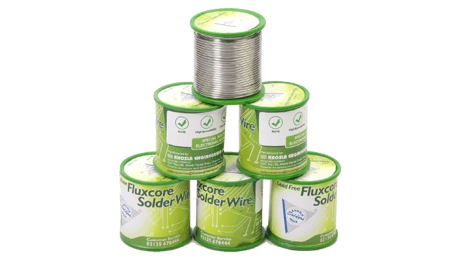
Choosing between lead-free and leaded solder wire is no longer only a question of soldering performance. For electronics manufacturers, engineers and procurement teams, the decision can also affect regulatory compliance, material documentation, production processes and the markets where the finished product can be sold. RoHS restricts certain hazardous substances in electrical and electronic equipment, including lead, making solder material selection an important consideration for applicable products.
Choosing between lead-free and leaded solder wire is only one part of selecting the right solder material. Alloy composition, flux type, wire diameter, residue requirements and application conditions also influence the final choice. For a more detailed selection framework, refer to our solder wire buying guide, which explains how to evaluate these factors before choosing a solder wire.
Lead-Free vs Leaded Solder Wire: What Is the Difference?
Lead-free and leaded solder wires primarily differ in their alloy composition and regulatory suitability. Leaded solder contains lead, commonly in tin-lead systems, while lead-free solder uses alternative alloy systems such as tin-silver-copper. For products subject to RoHS requirements, the choice depends on the applicable substance limits, product scope, exemptions, and supporting compliance documentation, not simply the solder label.
| Factor | Lead-Free Solder Wire | Leaded Solder Wire |
| Lead content | Designed without intentionally added lead or within applicable limits | Contains lead as an alloy constituent |
| Common alloy systems | Sn-Ag-Cu and other Pb-free alloys | Sn-Pb alloys |
| RoHS suitability | Common choice where lead restriction applies | May require a specific applicable exemption |
| Processing | May require different thermal profiles | Established process characteristics |
| Material selection | Based on alloy, flux, application and compliance | Based on alloy, application and regulatory scope |
| Documentation | Compliance evidence should be available | Compliance status and exemption should be verified where relevant |
For electronic-grade solder materials, IPC J-STD-006 covers requirements and test methods for electronic solder alloys and fluxed/non-fluxed solid solders, including wire, bar, ribbon and other forms.
What Does RoHS Mean for Solder Wire?
RoHS stands for Restriction of Hazardous Substances and is an EU framework restricting specified hazardous substances in electrical and electronic equipment. Lead is one of the restricted substances. For applicable products, RoHS compliance is assessed against maximum concentration values in homogeneous materials, subject to the Directive’s scope and applicable exemptions.
The European Commission states that RoHS currently restricts ten substances, including lead, mercury, cadmium, hexavalent chromium, PBB, PBDE and four phthalates.
Under the RoHS framework, the maximum concentration value for lead is 0.1% by weight in homogeneous materials.
This distinction is important because RoHS does not simply ask whether a product is “lead-free.” Compliance is determined against the requirements applicable to the finished electrical or electronic equipment and its materials.
The RoHS restricted substances include:
- Lead (Pb)
- Mercury (Hg)
- Cadmium (Cd)
- Hexavalent chromium [Cr(VI)]
- Polybrominated biphenyls (PBB)
- Polybrominated diphenyl ethers (PBDE)
- DEHP
- BBP
- DBP
- DIBP
Important: A solder wire being described as “lead-free” does not, by itself, constitute a complete RoHS compliance assessment. Buyers should evaluate the material declaration, applicable limits and documentation for the intended application.
Why Does RoHS Restrict Lead in Electronics?
RoHS restricts lead because the Directive is intended to reduce risks associated with hazardous substances in electrical and electronic equipment and their subsequent waste management. For manufacturers, this makes material selection part of regulatory compliance, especially when products are designed for markets where RoHS requirements apply.
The European Commission explains that RoHS aims to address al and public-health risks associated with hazardous substances in electrical and electronic equipment.
For soldering applications, lead can enter an electronic assembly through materials such as:
- Solder wire
- Solder paste
- Solder bars
- Component finishes
- PCB finishes
- Other metallic materials
Therefore, changing the solder wire alone may not be sufficient to establish complete product compliance.
A manufacturer should consider the entire material chain and identify where restricted substances may be introduced.
When Is Lead-Free Solder Wire Required?
Lead-free solder wire is generally selected when the finished electrical or electronic equipment falls within applicable RoHS requirements and no relevant exemption permits the use of restricted lead. The exact requirement depends on the equipment category, market, application, material composition and current exemption status, so compliance should be assessed against the applicable legislation.
The RoHS Directive covers a broad range of electrical and electronic equipment categories, including household appliances, IT and telecommunications equipment, consumer equipment, electrical and electronic tools, medical devices, monitoring and control equipment and other EEE.
A lead-free soldering material may therefore be appropriate when:
- The finished product is within RoHS scope.
- The applicable material must meet the lead concentration limit.
- No relevant exemption applies.
- The customer specification requires Pb-free materials.
- The destination market requires RoHS compliance.
- The manufacturer’s internal restricted-substance policy requires lead-free materials.
However, “lead-free” and “RoHS compliant” should not automatically be treated as interchangeable claims.
Can Leaded Solder Wire Still Be Used?
Yes, leaded solder wire can still be used in applications where its use is legally permitted, technically appropriate and consistent with the requirements governing the finished product. RoHS does not mean that every use of leaded solder is universally prohibited. Certain exemptions exist, but they are application-specific, limited and subject to changing regulatory requirements.
The European Commission explicitly maintains RoHS exemptions where specified conditions are met, and these exemptions are periodically reassessed.
The practical question is therefore not:
“Is leaded solder completely banned?”
Instead, manufacturers should ask:
“Does the intended application fall within RoHS scope, and is there a currently applicable exemption covering the use of lead?”
This distinction is extremely important for procurement and engineering teams.
Leaded solder may remain relevant where:
- The finished equipment is outside the applicable RoHS scope.
- A valid exemption applies to the particular application.
- The customer specification permits leaded solder.
- The product is intended for a market with different regulatory requirements.
- Existing equipment or repair requirements allow its use.
Always verify the current exemption applicable to the exact product category and application rather than relying on an old exemption number or generic supplier statement.
Lead-Free vs Leaded Solder Wire: What Is the Difference?
Lead-free and leaded solder wires differ mainly in alloy composition, regulatory suitability and processing characteristics. Leaded solder commonly uses tin-lead alloys, while lead-free solder uses alternative alloy systems without intentionally added lead. For electronics manufactured for RoHS-regulated markets, lead-free materials are generally selected when no applicable exemption permits lead-containing solder.
The distinction is important because solder selection is not based only on whether a wire contains lead. Manufacturers also need to consider the finished product, applicable regulations, soldering process, alloy composition, flux system and customer specifications.
| Factor | Lead-Free Solder Wire | Leaded Solder Wire |
| Main composition | Tin-based Pb-free alloy systems | Commonly tin-lead alloy systems |
| Lead | Designed to avoid restricted lead content | Contains lead |
| RoHS applications | Common choice where lead restriction applies | Requires assessment of applicable exemption |
| Processing | May require different process conditions | Often suited to established Sn-Pb processes |
| Regulatory documentation | Important for compliance verification | Important, particularly where exemptions are relevant |
| Material selection | Compliance + technical requirements | Regulatory permission + technical requirements |
For electronic-grade solder materials, IPC J-STD-006 covers requirements and test methods for electronic-grade solder alloys and fluxed or non-fluxed solder in forms including wire, bar, ribbon and powder.
The key point for manufacturers
The choice should not simply be:
“Lead-free is good and lead is bad.”
Instead, the correct question is:
“Which solder material meets the regulatory requirements and technical requirements of this particular product and application?”
That distinction makes this article different from a basic solder-alloy comparison and keeps the content aligned with the RoHS compliance intent.
How Leaded and Lead-Free Wire Behave Differently
Leaded and lead-free solder wires can behave differently during soldering because their alloy systems have different thermal and processing characteristics. Lead-free solder may require different process temperatures and thermal profiles, while established leaded solder processes can have a different operating window. Flux, surface condition and equipment also influence the final soldering result.
The difference is therefore not limited to chemical composition. When a manufacturer changes from a leaded solder wire to a lead-free solder wire, the production process may also need to be evaluated.
Important differences to consider
1. Processing temperature
Different solder alloy systems have different melting and processing characteristics. A change in alloy can therefore require adjustments to the soldering process.
2. Wetting behaviour
Wetting is influenced by the alloy, flux chemistry, surface condition, temperature and contact time. The solder alloy should therefore not be evaluated independently from the flux and application.
3. Flux requirements
The appropriate flux system can influence oxide removal, wetting, residue and overall joint formation.
4. Thermal sensitivity
Lead-free conversion may require careful consideration of components, PCB materials and other temperature-sensitive parts.
5. Process validation
A manufacturer should validate the new solder under actual production conditions instead of assuming that changing the spool is a direct one-to-one replacement.
Why this matters for RoHS conversion
A manufacturer moving to lead-free solder is making both a material decision and a process decision.
The evaluation should include:
- Alloy composition
- Soldering temperature
- Flux chemistry
- Wire diameter
- PCB finish
- Component compatibility
- Joint formation
- Rework process
- Quality inspection
- Reliability requirements
This is also why technical standards and product specifications are important when selecting electronic solder materials. IPC J-STD-006 classifies solder materials using factors including alloy composition, impurity level, solder form, dimensions, flux percentage and flux classification where applicable.
Is Lead-Free Solder Wire Automatically RoHS Compliant?
No, lead-free solder wire is not automatically proof of complete RoHS compliance. RoHS restricts ten substances, including lead, and applies according to the scope and requirements of the finished electrical or electronic equipment. A lead-free solder should therefore be supported by appropriate material information and compliance documentation rather than being treated as automatically RoHS compliant.
This is one of the most important points in the entire article.
The European Commission identifies ten restricted substances under the current RoHS framework, including lead, mercury, cadmium, hexavalent chromium, PBB, PBDE and four phthalates.
Therefore:
Lead-free ≠ automatically RoHS compliant.
A better compliance approach is:
Lead-free material + appropriate substance assessment + applicable product requirements + supporting documentation.
What should buyers verify?
Before approving a solder wire for a RoHS-sensitive application, procurement and quality teams should check:
- Alloy composition
- Lead content
- Other relevant restricted substances
- Supplier RoHS declaration
- Material declaration
- Technical Data Sheet
- Certificate of Analysis, where applicable
- Batch/lot traceability
- Customer-specific requirements
- Finished-product compliance requirements
The RoHS framework limits lead to 0.1% by weight in homogeneous materials, subject to the Directive’s applicable requirements and exemptions.
This is why simply seeing “Pb-Free” printed on packaging should not be treated as the complete compliance assessment.
What about Kothari Metsol?
For B2B customers purchasing solder materials from Kothari Metsol, best Lead Free Solder Wire Manufacturer in India, the most useful approach is to define the required alloy, flux system, dimensions, application and documentation requirements before material approval.
That creates a stronger technical procurement process than relying on generic “RoHS compliant” marketing language.
Why Does RoHS Restrict Lead in Electronics?
RoHS restricts lead and other specified hazardous substances in electrical and electronic equipment to reduce risks to human health and those associated with hazardous materials. For manufacturers, the restriction means that material selection, supplier documentation and product compliance must be considered together when designing or producing equipment intended for applicable regulated markets.
The European Commission explains that the RoHS framework aims to reduce risks associated with hazardous substances in electrical and electronic equipment and supports safer material use and improved recyclability.
Lead can enter an electronic product through multiple materials, including:
- Solder wire
- Solder paste
- Component finishes
- PCB finishes
- Platings
- Connectors
- Other metallic materials
Therefore, solder wire is only one part of the overall restricted-substance assessment.
Why solder wire matters
Solder is used to create electrical and mechanical connections between components, conductors and circuit boards. When lead-containing solder is used, the lead becomes part of the assembly’s material composition.
For a product within applicable RoHS scope, manufacturers therefore need to determine whether:
- Lead is restricted for the relevant material/application.
- The concentration is within the applicable limit.
- A specific exemption applies.
- The exemption is currently valid.
- The finished product meets the applicable requirements.
RoHS is not simply a “lead-free solder rule”
This is an important distinction for readers searching for RoHS soldering requirements.
RoHS is a broader restricted-substance framework. Lead is one of several controlled substances, meaning a manufacturer’s compliance process should cover the whole product, not only the solder wire.
This makes supplier documentation, material declarations and traceability increasingly important for electronics manufacturers.
RoHS in India: E-Waste (Management) Rules, 2022
India’s E-Waste (Management) Rules, 2022 establish an extended producer responsibility framework for covered electrical and electronic equipment and include provisions concerning restricted substances in Schedule I.
For manufacturers and importers supplying electronics in India, material and product compliance should therefore be assessed against the applicable Indian rules as well as any additional requirements of export markets.
This section is particularly valuable because it gives the article an India-specific compliance angle instead of making the content entirely EU-focused.
India’s Ministry of Forest and Climate Change published the E-Waste (Management) Rules, 2022, and the official rules include Schedule I provisions covering restricted substances and specified exemptions.
The Ministry’s official rules-and-regulations portal also lists the E-Waste (Management) Rules, 2022 and subsequent amendments, including the 2024 amendment.
What does this mean for solder materials?
For an electronics manufacturer, the compliance question should not stop at:
“Is my solder wire lead-free?”
Instead, the manufacturer should consider:
- What electrical/electronic equipment is being manufactured?
- Is it covered by the applicable Indian rules?
- What restricted-substance requirements apply?
- What material composition is being used?
- What documentation is available from suppliers?
- Are there customer-specific requirements?
- Is the product also being exported to another regulated market?
India vs EU: Do not assume they are identical
One important SEO and E-E-A-T point is that the article should not claim that India’s E-Waste Rules 2022 are simply the Indian version of EU RoHS.
They are separate regulatory frameworks.
A company manufacturing in India may also need to satisfy EU RoHS requirements when its products are placed on the EU market, while products supplied within India need to be assessed against the applicable Indian requirements.
This distinction is especially important for Indian electronics manufacturers serving both domestic and international customers.
India’s rules also contain specified exemptions
The official 2022 rules include entries concerning particular lead uses, including certain solder applications.
Therefore, just as with EU RoHS, manufacturers should check the exact regulatory provision and application rather than assuming that all lead-containing solder is prohibited.
Practical compliance approach for Indian manufacturers
A robust process can follow:
Product → Applicable regulation → Restricted substances → Material composition → Exemption check → Supplier documentation → Production validation → Record keeping
This gives the reader a practical answer rather than simply repeating regulatory terminology.
When Is Lead-Free Solder Wire Required?
Lead-free solder wire is generally required when an electrical or electronic product is subject to a restriction on lead and no applicable exemption permits its use. The decision depends on the product’s regulatory scope, destination market, customer requirements and applicable exemption status. Manufacturers should confirm these factors before selecting a solder material for production.
Lead-free solder is generally the appropriate choice when:
- The finished product is subject to applicable RoHS requirements.
- No relevant lead exemption applies.
- The customer specification requires Pb-free solder.
- The product is intended for a market with lead restrictions.
- The manufacturer has an internal restricted-substance policy.
- The product must meet a defined Pb-free material specification.
- The production process has been validated for the selected lead-free alloy.
But lead-free is not automatically required in every application
There can be situations where lead-containing solder remains technically or legally permissible.
For example:
- The product may fall outside the applicable regulatory scope.
- A specific exemption may apply.
- A customer specification may permit leaded materials.
- The product may be intended for an application with different regulatory requirements.
The European Commission confirms that RoHS exemptions can apply under defined conditions and that exemptions are periodically reassessed based on technical, al, health and socioeconomic considerations.
India’s E-Waste (Management) Rules, 2022 also contain specified exemptions within their restricted-substance provisions.
A simple decision framework
| Question | If YES | If NO |
| Is the product subject to applicable RoHS/restricted-substance requirements? | Continue compliance assessment | Check other applicable requirements |
| Is lead restricted for the relevant application? | Evaluate lead-free solder | Leaded may remain an option |
| Does a valid exemption apply? | Verify exemption conditions | Lead-free is generally the safer regulatory route |
| Does the customer require Pb-free material? | Use an appropriate Pb-free specification | Evaluate technical/regulatory requirements |
| Has the lead-free process been validated? | Proceed through quality approval | Conduct process validation first |
What should manufacturers do before ordering?
A professional procurement process should confirm:
1. Regulatory scope
Identify the rules applicable to the finished product.
2. Market requirements
Consider India, EU or other destination-market requirements.
3. Exemptions
Verify whether a current exemption applies.
4. Solder specification
Define alloy, wire diameter, flux and other technical requirements.
5. Documentation
Obtain the relevant compliance and technical documents.
6. Process validation
Confirm that the selected lead-free solder performs correctly in production.
For Kothari Metsol customers, this approach also provides a useful framework for communicating the exact solder material specification required for a particular application, rather than selecting a product solely by the words “lead-free.”
RoHS Exemptions: When Can Leaded Solder Be Permitted?
RoHS exemptions allow specified uses of restricted substances when the conditions in the Directive are satisfied. They are not blanket permissions to use leaded solder. Exemptions have defined scopes and validity periods and can be amended, renewed or allowed to expire as alternatives and technical conditions change.
The European Commission states that RoHS exemptions are limited in time and periodically reassessed, considering factors such as substitute availability, technical feasibility, reliability, health and all impacts, and socioeconomic effects.
The Directive itself provides exemptions for specific applications in Annexes III and IV.
What manufacturers should verify
Before specifying leaded solder for a RoHS-related application, check:
- Product category
- RoHS applicability
- Specific soldering application
- Current exemption number
- Scope of that exemption
- Applicable expiry or review status
- Customer requirements
- Destination market
- Compliance documentation
This is especially important because an exemption that applied to one category or application may not apply to another.
Lead-Free vs Leaded Solder Wire for Electronics Manufacturing
The choice between lead-free and leaded solder wire affects more than regulatory status. Manufacturers must also consider alloy composition, soldering temperature, flux chemistry, component compatibility, joint requirements, process capability, rework procedures and reliability. The correct choice is therefore a combined engineering and compliance decision rather than a simple material substitution.
Lead-free conversion can require process validation because the selected alloy may behave differently from an established tin-lead process.
Relevant considerations include:
- Soldering temperature
- Thermal profile
- Component temperature limits
- PCB construction
- Surface finish
- Flux chemistry
- Wetting behaviour
- Joint appearance
- Rework requirements
- Process window
- Long-term reliability
- Equipment capability
IPC identifies J-STD-001 as a major industry standard addressing materials, methods and verification criteria for soldered leaded and lead-free interconnections.
Therefore, simply replacing one spool of solder wire with another alloy without validating the process can create unnecessary manufacturing problems.
How RoHS Affects Solder Wire Selection
RoHS affects solder wire selection by making restricted-substance compliance one of the material-selection criteria for applicable products. Engineering and procurement teams should evaluate the alloy, lead concentration, flux system, documentation, product scope and destination market together before approving a solder wire for production.
A practical selection process should include:
1. Identify the finished product
Determine whether the equipment is within the applicable RoHS scope.
2. Identify the destination market
Requirements can differ between markets and customer specifications.
3. Establish the material requirement
Determine whether the solder needs to be lead-free or whether a permitted exemption exists.
4. Select the alloy
Consider the required soldering process and joint performance.
5. Verify flux compatibility
Flux selection can affect wetting, residue and process performance.
6. Request documentation
Obtain appropriate compliance and technical documentation from the supplier.
7. Validate the process
Confirm that the selected solder performs correctly under actual manufacturing conditions.
This approach is considerably safer than selecting solder solely because the packaging says “RoHS compliant.”
What Compliance Documents Should Buyers Check?
Buyers should request documents that allow them to verify solder composition, restricted-substance status and product traceability. Depending on the application, useful documentation can include a technical data sheet, certificate of analysis, material declaration, RoHS declaration, safety data sheet and relevant test or compliance evidence.
A professional procurement process should distinguish between technical documentation and regulatory declarations.
| Document | What it helps verify |
| Technical Data Sheet (TDS) | Alloy, dimensions, flux and technical characteristics |
| Certificate of Analysis (COA) | Actual batch-related composition or test information |
| RoHS Declaration | Supplier’s declaration regarding RoHS requirements |
| Material Declaration | Substance/material information |
| Safety Data Sheet (SDS) | Hazard, handling and safety information where applicable |
| Product Specification | Agreed technical requirements |
| Test Report | Supporting analytical or compliance evidence |
| Batch/lot information | Traceability and production identification |
IPC J-STD-006 classifies electronic solder materials according to factors including alloy composition, impurity level, solder form, dimensions, flux percentage and flux classification where applicable.
Lead-Free vs Leaded Solder Wire: Quick Comparison
Lead-free solder wire is generally the preferred route for RoHS-regulated electronic products where no applicable lead exemption exists, while leaded solder remains technically relevant where regulations and specifications permit it. The correct selection should consider compliance, alloy, process temperature, flux, reliability, documentation and the requirements of the finished product.
| Selection factor | Lead-Free | Leaded |
| RoHS-regulated application | Generally preferred where no exemption applies | Requires verification of applicable exemption/status |
| Lead restriction | Designed to meet Pb-free requirements | Contains Pb |
| Alloy systems | Commonly tin-based Pb-free alloys | Commonly tin-lead alloys |
| Process validation | Required when changing process/material | Usually established for existing Sn-Pb processes |
| Thermal profile | May differ from Sn-Pb | Established according to alloy/process |
| Flux requirements | Application dependent | Application dependent |
| Documentation | RoHS/material evidence important | Compliance/exemption evidence may be required |
| Manufacturing decision | Compliance + engineering | Regulatory permission + engineering |
Is Every Lead-Free Solder Wire RoHS Compliant?
No. “Lead-free” does not automatically mean that the complete soldering material or finished electronic product is RoHS compliant. RoHS covers multiple restricted substances and applies according to product scope and material limits. A responsible assessment should therefore consider the solder composition, other restricted substances, applicable requirements and supporting supplier documentation.
This is an important distinction for purchasing teams.
A solder alloy can be free from intentionally added lead but still require further assessment against other restricted substances or customer requirements.
For example, the RoHS framework currently addresses ten restricted substances.
Therefore, procurement teams should avoid using:
“Lead-free = automatically RoHS compliant.”
A better approach is:
“Verify the material against the applicable RoHS requirements and obtain appropriate documentation.”
Is RoHS Compliance the Same as Lead-Free Compliance?
No. Lead-free describes the material’s lead content or alloy design, while RoHS compliance is a broader regulatory assessment. RoHS restricts multiple substances and applies to electrical and electronic equipment within its scope. Therefore, lead-free solder can support RoHS compliance, but the finished product still requires an appropriate overall compliance assessment.
This distinction matters because solder wire is only one material used in an electronic assembly.
Other potential material sources include:
- Components
- PCB finishes
- Platings
- Cables
- Plastics
- Adhesives
- Connectors
- Mechanical parts
Consequently, a manufacturer should maintain a broader restricted-substance management process rather than treating solder wire as the sole compliance factor.
Lead-Free Solder Wire and Process Considerations
Lead-free solder wire can require different process conditions from conventional tin-lead solder. Before production use, manufacturers should validate soldering temperature, flux activity, component compatibility, wetting, joint formation and rework procedures. The objective is not merely to achieve regulatory compliance but to establish a stable manufacturing process.
When moving from leaded to lead-free solder, evaluate:
Soldering process
- Iron or equipment temperature
- Contact time
- Thermal profile
- Heat transfer
- Tip condition
Material performance
- Wetting
- Flow
- Joint formation
- Residue
- Spatter
- Oxidation behaviour
Assembly considerations
- PCB finish
- Component finish
- Thermal sensitivity
- Pad design
- Joint geometry
Quality control
- Visual inspection
- Solderability testing
- Process monitoring
- Batch traceability
- Defect analysis
This is why a lead-free conversion should be treated as a controlled engineering change, rather than simply a purchasing substitution.
What Role Does Flux Play in RoHS-Compliant Soldering?
Flux does not determine RoHS compliance by itself, but its chemistry and classification are important parts of soldering-material selection. A suitable flux system helps remove oxides and improve wetting, while its residue and process characteristics must match the application. Buyers should therefore evaluate flux composition and documentation alongside the solder alloy.
For flux-cored solder wire, the solder alloy and flux are part of the same material system.
Consider:
- Flux type
- Flux percentage
- Flux classification
- Residue characteristics
- Cleaning requirements
- Soldering process
- Component sensitivity
- Surface condition
IPC’s soldering standards distinguish solder-alloy requirements from flux requirements, with J-STD-006 covering electronic-grade solder alloys and J-STD-004 covering soldering fluxes.
How Should Manufacturers Choose Solder Wire for RoHS-Regulated Products?
Manufacturers should start with the finished product’s regulatory requirements, then select an appropriate solder alloy and flux system that can meet the required process and reliability targets. The final material should be supported by adequate technical and compliance documentation and validated under the manufacturer’s actual soldering conditions.
Recommended decision process
Step 1 — Regulatory requirement
Determine whether the finished equipment falls within RoHS scope.
Step 2 — Lead requirement
Determine whether lead is restricted or whether a valid exemption applies.
Step 3 — Alloy selection
Select an appropriate lead-free or leaded alloy based on the application.
Step 4 — Flux selection
Choose a flux chemistry compatible with the surfaces and process.
Step 5 — Documentation
Request TDS, COA, RoHS declaration and other required documents.
Step 6 — Process validation
Test the solder under actual production conditions.
Step 7 — Quality control
Maintain a lot of traceability and incoming-material verification.
How Kothari Metsol Supports Solder Material Selection
Kothari Metsol can support industrial and electronics customers by providing soldering materials suited to different alloy, flux and application requirements.
For compliance-sensitive applications, customers should communicate their required alloy, product specification, dimensions, flux system, regulatory destination and documentation requirements so the appropriate material can be evaluated before production approval.
For Kothari Metsol, the strongest content strategy is to demonstrate technical capability and documentation, rather than repeatedly claiming to be the “best” or “leading” manufacturer.
Relevant information to communicate to B2B customers can include:
- Alloy composition
- Solder wire diameter
- Flux type
- Flux percentage
- Product specifications
- Packaging
- Batch information
- Technical documentation
- Applicable standards
- Compliance documentation
- Application suitability
Lead-Free vs Leaded Solder Wire: What Should Engineers Check Before Switching?
Engineers should check regulatory requirements, alloy compatibility, soldering temperature, component limitations, PCB finish, flux chemistry, joint performance, rework procedures and supplier documentation before switching solder types. A material change should also be validated through controlled trials because differences in alloy behaviour can affect process stability and finished-joint performance.
Engineering checklist
| Check | Why it matters |
| RoHS scope | Establishes regulatory requirement |
| Lead restriction | Determines material direction |
| Exemption status | May affect whether leaded solder is permitted |
| Alloy composition | Affects process and joint characteristics |
| Melting/processing behaviour | Affects thermal profile |
| Flux chemistry | Affects wetting and residue |
| PCB/component finish | Affects solderability |
| Equipment capability | Determines process suitability |
| Rework method | May require process changes |
| Documentation | Supports compliance and traceability |
| Reliability requirements | Confirms application suitability |
Lead-Free vs Leaded Solder Wire: Common Selection Mistakes
The most common mistakes are assuming that all lead-free solder is automatically RoHS compliant, treating RoHS as a blanket ban on lead, ignoring exemptions, relying only on supplier labels, and changing solder without process validation. These mistakes can create regulatory, quality and manufacturing risks even when the selected solder appears technically suitable.
Avoid these mistakes:
- Assuming “lead-free” automatically means full RoHS compliance.
- Assuming all leaded solder is prohibited.
- Using an outdated RoHS exemption.
- Failing to identify the finished-product category.
- Selecting solder only by alloy name.
- Ignoring flux chemistry.
- Changing solder without process trials.
- Failing to request compliance documentation.
- Ignoring customer-specific restrictions.
- Treating supplier declarations as a substitute for product-level compliance assessment.
Lead-Free vs Leaded Solder Wire: Quick Decision Guide
Choose lead-free solder when the applicable product requirements restrict lead and no relevant exemption permits its use. Consider leaded solder only when the governing requirements allow it and the application is technically appropriate. In both cases, verify the alloy, flux, documentation, process requirements and destination-market regulations before approving the material.
| If your situation is… | Consider… |
| RoHS applies and no lead exemption is available | Lead-free solder |
| Customer specifically requires Pb-free | Lead-free solder |
| Product is outside applicable RoHS scope | Evaluate based on technical/regulatory requirements |
| A valid lead exemption applies | Leaded solder may be permissible |
| Existing Sn-Pb process is being converted | Validate lead-free process carefully |
| Export product has multiple market requirements | Evaluate each applicable market |
| Compliance documentation is unclear | Stop and verify before production |
Frequently Asked Questions
1. Is lead-free solder wire required for RoHS compliance?
For electrical and electronic equipment within applicable RoHS scope, lead-free solder is generally required when the use of lead would exceed the permitted concentration and no applicable exemption covers that use. The exact determination depends on the product category, material limits and current exemption status, so manufacturers should verify the specific regulatory requirement before selecting solder.
2. Is leaded solder wire RoHS compliant?
Leaded solder wire is not automatically RoHS compliant because lead is a restricted substance under RoHS. However, certain applications may fall under specific exemptions. Manufacturers should therefore check whether the finished product is within scope and whether a current exemption specifically covers the intended application before using leaded solder.
3. What is the RoHS limit for lead?
The RoHS maximum concentration value for lead is 0.1% by weight in homogeneous materials. This value should not be interpreted as a blanket specification for every solder alloy because RoHS compliance depends on the applicable product, material and regulatory requirements. Specific exemptions can also modify whether a restricted substance may be used in defined applications.
4. Does lead-free solder automatically mean RoHS compliant?
No. Lead-free solder addresses the presence of lead, but RoHS covers ten restricted substances and applies according to the scope of the electrical or electronic equipment. Buyers should therefore verify the solder’s material composition and relevant supplier documentation instead of relying only on the term “lead-free” when establishing compliance.
5. Can leaded solder still be used in electronics?
Yes, leaded solder can still have legitimate technical applications where its use is permitted by the applicable regulatory requirements, product specification or exemption. However, manufacturers should not assume that an old exemption remains valid. The exact application, equipment category and current exemption status should be verified before approving lead-containing solder for production.
6. What documents should I request from a solder wire supplier?
Depending on the application, buyers should request a technical data sheet, certificate of analysis, material or substance declaration, RoHS declaration and relevant safety or compliance documentation. Batch identification and traceability can also be important for industrial production. The exact documentation package should match the customer’s quality system and regulatory requirements.
7. Is lead-free solder a direct replacement for leaded solder?
Not necessarily. A lead-free solder alloy can require different processing conditions and may behave differently from a leaded alloy. Before replacing an established solder, manufacturers should validate temperature, wetting, joint formation, component compatibility, flux behaviour, rework and reliability under the actual production conditions rather than assuming a direct one-to-one substitution.
Final Takeaway: Lead-Free vs Leaded Solder Wire and RoHS
The key difference is that lead-free solder is designed to avoid the use of lead where regulatory or application requirements demand it, while leaded solder remains usable in permitted applications. RoHS compliance, however, is broader than simply choosing lead-free solder. Manufacturers must evaluate product scope, restricted substances, exemptions, documentation and process requirements before approving a solder material.
For a practical B2B decision, remember:
RoHS requirement → Product scope → Lead restriction → Exemption check → Alloy selection → Flux selection → Documentation → Process validation
That approach is more reliable than selecting solder based only on a “lead-free” or “RoHS” label.
For electronics manufacturers, procurement teams and engineering departments, the most important point is simple: select solder wire according to the finished product’s regulatory requirements and actual manufacturing conditions, then maintain evidence supporting that decision.