
Solder Wire Material: Price vs Quality Guide
Ask any procurement team what “best solder wire” means, and you’ll usually get one of two answers: the cheapest option that gets the job done, or the highest-spec option regardless of cost. Neither answer is quite right – the actual best solder wire is the one that matches your application’s requirements at a price that reflects genuine quality, not just a low quote.
That distinction matters most when you’re buying solder wire material at scale, since a poor value-for-quality decision doesn’t show up as an obvious defect on delivery – it shows up weeks later as inconsistent joints, unexplained rework, or a solder wire price that turns out to have hidden costs downstream.
This guide breaks down what actually drives solder wire price, how to evaluate whether a quote reflects real quality, and what factors define the best solder wire for your specific application before you commit to a large order.
What Is Solder Wire Material?
Solder wire material refers to the metal alloy used to form electrical and mechanical joints in soldering – traditionally tin-lead alloys, or lead-free formulations like SAC (tin-silver-copper) for RoHS-compliant applications. The alloy’s purity, composition accuracy, and manufacturing consistency all directly determine how well it wets, bonds, and performs over the life of the joint.
Solder material comes as solid wire, with no internal flux, or flux-core wire with flux built in – and both are used across electronics assembly, cable manufacturing, transformer winding, and general industrial soldering.
What Actually Drives Solder Wire Price
Solder wire price varies more than most buyers expect for what looks like a similar product on paper, and the differences usually come down to identifiable factors:
- Raw material cost fluctuation. Tin, silver, and copper prices shift with global commodity markets, and alloy composition directly affects how sensitive a given solder wire is to those swings.
- Alloy purity and quality control. Manufacturers running rigorous purity testing and batch documentation typically price higher than those without, but deliver more predictable, defect-free performance.
- Flux formulation, for flux-core wire. More sophisticated flux chemistries – urea, specialized no-clean formulations – cost more to produce than basic rosin core.
- Manufacturing scale and process control. In-house manufacturers with tight diameter tolerance control often price differently than smaller operations with looser tolerances.
- Manufacturer vs supplier margin. Buying directly from a manufacturer typically avoids the additional markup a reselling supplier adds.
- Compliance certification. RoHS and other compliance documentation adds testing and paperwork cost that reflects in the final solder wire price.
What Does “Best Solder Wire” Actually Mean?
There’s no single best solder wire – the right choice depends entirely on your application, and treating it as a universal ranking leads buyers astray. The best solder wire for high-volume consumer electronics assembly (typically SAC305 lead-free, flux-core, tight diameter tolerance) is a poor fit for heavy industrial cable termination work, and vice versa.
Instead of searching for a single “best” product, define what matters most for your specific use case: alloy compatibility with your components, required melting point range, flux type suited to your process, and diameter matched to your equipment. The best solder wire is the one that’s correctly specified for your application, not the most expensive or most marketed option.
Solid Solder Wire vs Flux Core: Price and Performance Trade-offs
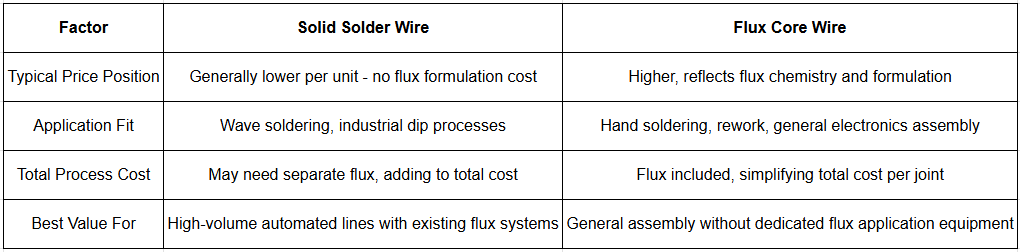
Evaluating “cheaper” solder wire material in isolation misses the bigger picture – solid solder wire’s lower unit price can be offset by the added cost of separately sourcing and applying flux, depending on your process.
Evaluating Quality Behind a Solder Wire Price Quote
Before comparing quotes purely on solder wire price, verify what’s actually behind the number:
- Request a certificate of analysis for alloy composition and purity – a lower price with no supporting documentation is a red flag, not a bargain.
- Ask about diameter tolerance guarantees. Looser tolerances often explain a lower price but cause feed inconsistency on automated equipment.
- Check flux activity documentation for flux-core wire. Inconsistent flux percentage between batches leads to unpredictable wetting, regardless of the headline price.
- Confirm compliance certification is independently verifiable, not just a claim on the data sheet.
- Request a sample trial before a bulk commitment, so you can weigh actual performance against the quoted price.
Solder Wire for Electronics: What Justifies a Premium
Solder wire for electronics applications often commands a higher price than general industrial solder wire, and that premium is usually justified by real requirements: tighter diameter tolerance for fine-pitch components, RoHS compliance testing and documentation, and more rigorous purity control to avoid conductivity issues on sensitive circuits.
Buyers evaluating electronics-grade solder wire should expect to pay more than general-purpose industrial wire, and should be cautious of unusually low pricing on products claiming electronics-grade specifications without supporting test data.
Choosing Reliable Solder Wire Suppliers on Value, Not Just Price
Evaluate solder wire suppliers on the full value equation, not the lowest line-item price:
- Do they manufacture in-house, giving direct control over alloy composition and consistent quality?
- Can they explain clearly what drives their solder wire price relative to competitors?
- Do they provide batch documentation and traceability that justifies their pricing?
- Can their technical team advise on the right alloy and specification for your specific application, potentially saving cost through better initial specification?
- What is their track record supporting bulk, recurring orders reliably?
Common Pricing Mistakes in Bulk Procurement
- Comparing solder wire price without matching specifications exactly. A lower quote for a different alloy grade or diameter tolerance isn’t a genuine comparison.
- Assuming the cheapest quote is the best value. Hidden costs from rework, inconsistent quality, or missing documentation often exceed the initial savings.
- Not requesting sample trials before bulk commitment. A small test run reveals real performance that a price quote alone can’t show.
- Ignoring total process cost for solid solder wire. Separately sourced flux adds cost that should factor into any price comparison against flux-core wire.
- Overlooking compliance documentation costs. Skipping RoHS or purity certification to save money can create compliance risk that costs far more later.
Frequently Asked Questions
1. What determines solder wire price?
Solder wire price is driven by raw material costs (tin, silver, copper), alloy purity and quality control, flux formulation complexity for flux-core wire, manufacturing scale, and whether you’re buying from a manufacturer or a reselling supplier.
2. What is the best solder wire for electronics manufacturing?
The best solder wire for electronics is typically a lead-free SAC alloy with flux-core construction, tight diameter tolerance, and verified RoHS compliance – though the exact specification depends on your components and process.
3. Is solid solder wire cheaper than flux core wire?
Solid solder wire generally has a lower unit price since it doesn’t include flux formulation cost, but total process cost may be similar once separately applied flux is factored in.
4. How can I verify solder wire material quality before a bulk order?
Request a certificate of analysis for alloy purity, verify diameter tolerance, check flux activity documentation for flux-core wire, and run a sample trial before committing to full order volume.
5. Why do some solder wire suppliers offer significantly lower prices?
Lower prices often reflect reduced purity testing, looser diameter tolerance, or lack of compliance documentation – verify these factors rather than assuming a lower price represents equal quality.
6. Does solder wire for electronics need to meet different standards than industrial solder material?
Yes, electronics applications generally require tighter diameter tolerance and RoHS compliance verification, while industrial applications may prioritize joint strength and thermal performance differently.
7. Should I choose solder wire suppliers based on price alone?
No, evaluate suppliers on total value – manufacturing control, batch documentation, technical support, and pricing transparency – since the lowest price often carries hidden downstream costs.
8. How do I compare solder wire price quotes fairly across suppliers?
Ensure quotes reflect identical alloy grade, diameter tolerance, and flux specification before comparing, since differing specifications make a direct price comparison misleading.
Conclusion
There’s no universal best solder wire – only the right solder wire material correctly specified for your application, backed by verifiable quality documentation and a price that genuinely reflects that quality. Understanding what drives solder wire price helps procurement teams compare quotes meaningfully instead of chasing the lowest number.
Kothari Metsol Pvt. Ltd. has manufactured solid solder wire, flux core wire, and solder material since 1967, combining German technical heritage with stringent quality control to serve electronics, automotive, and industrial manufacturers across India. If you’re evaluating solder wire price quotes or want help specifying the right solder wire for your application, our technical team is ready to help.
Explore our solid solder wire range and request technical guidance or a quotation.