
Zinc Anode Life Expectancy: What Determines It
Ask how long a zinc anode lasts, and the honest answer is: it depends on more variables than most buyers expect. Two anodes that look identical on a spec sheet can have very different service lives once installed, simply because of where and how they’re protecting a structure.
Understanding what actually determines zinc anode life expectancy matters because these components typically work unattended for years – by the time an underperforming anode becomes obvious, the structure it was protecting may already be corroding.
This guide breaks down the real factors that determine how long a zinc anode lasts, so you can plan replacement schedules with confidence rather than guessing.
Why Zinc Anode Life Expectancy Varies So Much
Zinc anode life expectancy depends on the balance between how much protective current the anode needs to supply and how much total zinc mass is available to supply it. Since current demand varies enormously based on the structure’s size, environment, and exposure conditions, there’s no single universal answer to “how long does a zinc anode last.”
This is why working with a knowledgeable zinc anode supplier who calculates expected life for your specific application matters more than relying on generic published figures that may not reflect your actual installation conditions.
How Sacrificial Protection Consumption Works
A zinc anode protects a structure by corroding preferentially, since zinc is more electrochemically reactive than the steel or metal it protects. As this galvanic process runs, the anode gradually loses mass – this consumption is the anode “doing its job,” not a defect or failure.
The rate of this consumption directly determines service life: an anode consuming faster under high current demand will deplete sooner than one operating under lower demand, even if both started with identical mass and composition.
Key Factors That Determine Zinc Anode Life Expectancy
Surface area of the protected structure. Larger structures generally require more total current, which increases consumption rate relative to a given anode’s mass.
Environmental exposure conditions. Saltwater environments typically drive faster consumption than freshwater or soil due to higher conductivity and more aggressive corrosion activity on the protected structure.
Anode alloy composition and purity. Properly formulated alloys with controlled trace elements maintain consistent, predictable consumption rates, while impure or poorly manufactured anodes can passivate – stopping effective protection prematurely even though zinc mass remains.
Total anode mass relative to current demand. A larger zinc anode rod supplies more total protective capacity before depletion, extending service life for a given current demand.
Coating condition of the protected structure. A well-coated structure requires less protective current than bare or poorly coated steel, extending anode life since less current demand means slower consumption.
Water or soil chemistry, where applicable. Factors like conductivity, temperature, and mineral content influence how efficiently the galvanic protection circuit operates.
Typical Service Life Ranges by Application
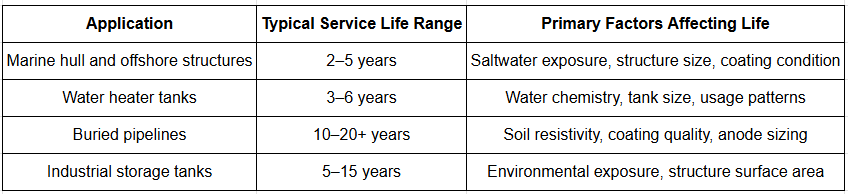
These ranges are general guidance – actual service life for your specific installation depends on the combination of factors above, and a supplier experienced in cathodic protection design can provide a more precise estimate based on your structure’s details.
How to Calculate Expected Zinc Anode Rod Life
Estimating zinc anode rod life expectancy involves comparing the total protective current your structure requires against the anode’s total available capacity, accounting for the alloy’s efficiency and expected consumption rate under your specific environmental conditions.
This calculation typically requires input on structure surface area, coating condition, environmental exposure type, and the specific anode’s mass and alloy composition. Rather than attempting this in isolation, most buyers work directly with their zinc anode supplier or manufacturer, who can apply established cathodic protection design methodology to their specific installation.
Signs Your Zinc Anode Is Nearing End of Life
- Visible mass loss – a significantly reduced anode compared to its original size, often 50% or more consumed depending on the specific replacement guideline for your application
- Increased corrosion activity appearing on the protected structure despite the anode still being physically present
- Passivation symptoms – an anode that appears largely intact but shows signs of a dull, crusty surface layer that may indicate it’s no longer providing effective current output
- Scheduled inspection intervals reaching their planned replacement point, based on the original service life calculation
Regular inspection, particularly for critical structures, helps catch these signs before protection gaps develop.
Extending Zinc Anode Life Through Proper Selection
- Choose the correct alloy grade for your environment. Marine, freshwater, and soil applications benefit from different formulations optimized for their specific conditions.
- Size the anode appropriately for your structure, rather than defaulting to a generic size that may under-protect or unnecessarily oversize the installation.
- Maintain good structure coating condition where applicable, since reduced current demand from better-coated structures extends anode life.
- Source from reputable zinc anode manufacturers in India with documented purity and consumption rate testing, since inconsistent alloy quality can cause premature passivation regardless of correct sizing.
- Verify core or strap attachment quality during installation, since a poor electrical connection can effectively shorten usable anode life even if zinc mass remains.
Planning Replacement Before Protection Fails
Because zinc anodes work invisibly and often in inaccessible locations, planning replacement proactively – based on calculated service life and periodic inspection – is far more reliable than waiting for visible corrosion damage to signal a problem. For critical infrastructure, marine assets, or buried structures, establishing a documented inspection and replacement schedule from the outset protects both the asset and the long-term cost of your corrosion protection program.
Frequently Asked Questions
1. How long does a zinc anode typically last?
Zinc anode life expectancy varies widely by application – from 2–5 years for marine structures to 10–20+ years for buried pipelines – depending on environmental exposure, structure size, and anode sizing.
2. What factors most affect zinc anode life expectancy?
The structure’s surface area, environmental exposure conditions, anode alloy purity, total anode mass relative to current demand, and the protected structure’s coating condition all significantly affect zinc anode life expectancy.
3. How can I calculate the expected life of a zinc anode rod for my structure?
Calculating expected life requires comparing your structure’s protective current demand against the anode’s total capacity under your specific environmental conditions – most buyers work with their zinc anode supplier to apply this calculation accurately.
4. What are the signs that a zinc anode needs replacement?
Signs include significant visible mass loss, increased corrosion activity on the protected structure, a dull or crusty passivated surface layer, or reaching a scheduled inspection replacement point.
5. Does zinc anode alloy quality affect how long it lasts?
Yes, properly formulated, high-purity alloys maintain consistent consumption rates, while impure or poorly manufactured anodes can passivate prematurely, effectively shortening usable protective life even with remaining zinc mass.
6. Why do marine zinc anodes have a shorter life expectancy than buried pipeline anodes?
Saltwater environments have higher conductivity and more aggressive corrosion activity, driving faster anode consumption compared to the generally lower current demand seen in buried soil applications.
7. Can I extend zinc anode life through proper selection and installation?
Yes, choosing the correct alloy grade for your environment, sizing the anode appropriately, maintaining good structure coating condition, and ensuring proper core attachment during installation can all help maximize service life.
8. How do I find reliable zinc anode manufacturers in India for accurate life expectancy data?
Look for manufacturers who provide documented alloy purity certification, current output and consumption rate testing data, and technical support to calculate expected service life for your specific application.
Conclusion
Zinc anode life expectancy isn’t a fixed number – it’s the result of structure size, environmental exposure, alloy quality, and proper sizing all working together. Understanding these factors, and planning inspection and replacement proactively, protects your structure from the corrosion damage that shows up only after protection has already quietly failed.
Kothari Metsol Pvt. Ltd. has manufactured zinc-based industrial products since 1967, combining German technical heritage with stringent quality control to serve galvanizing, marine, and industrial infrastructure sectors across India. If you’d like help calculating expected service life or selecting the right zinc anode rod for your structure, our technical team is ready to assist.
Explore our zinc anode range and request technical guidance or a quotation.