Introduction
In electronics and metal joining, many people confuse soldering flux with solder paste. Both help create strong solder joints, but they work in different ways. Choosing the right material improves bonding, saves production time, and reduces defects.
At Kothari Metsol, we supply high-quality soldering materials for industrial and commercial use. Our products support reliable soldering performance across electronics, automotive, electrical, and manufacturing sectors.
This guide explains the full difference between soldering flux and solder paste so you can choose the right product for your process.
What Is Soldering Flux?
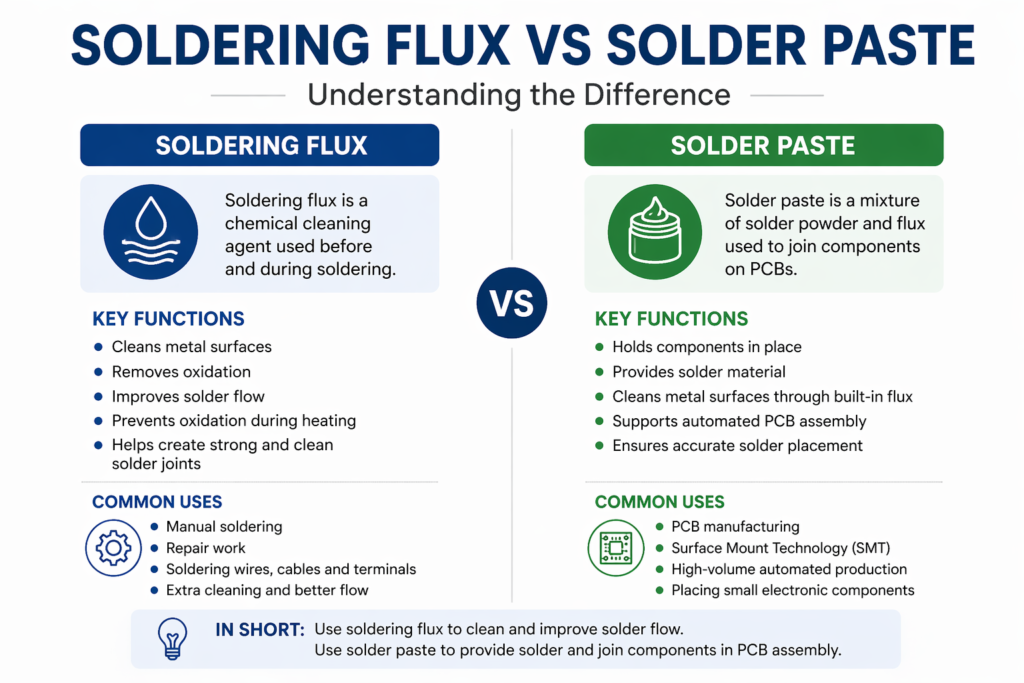
Soldering flux is a chemical cleaning agent used before and during soldering. It removes oxide layers from metal surfaces and helps molten solder flow smoothly.
Without proper soldering flux, solder may not stick well. This can lead to weak joints, poor conductivity, and early failure.
Main Functions of Soldering Flux
- Cleans metal surfaces
- Removes oxidation
- Improves solder flow
- Prevents new oxidation during heating
- Helps create strong and clean solder joints
Common Types of Soldering Flux
- Rosin Flux
- Water-Soluble Flux
- No-Clean Flux
- Organic Acid Flux
- Inorganic Flux
Choosing the right soldering flux depends on your application, temperature, and metal type.
What Is Solder Paste?
Solder paste is a mixture of powdered solder alloy and flux. It comes in paste form and is mainly used in PCB assembly and surface-mount technology (SMT).
Unlike soldering flux, solder paste already contains solder metal inside it.
Manufacturers apply solder paste directly to PCB pads before placing electronic components.
Main Functions of Solder Paste
- Holds components in place
- Provides solder material
- Cleans metal surfaces through built-in flux
- Supports automated PCB assembly
Solder paste is common in high-speed production lines where accuracy matters.
Soldering Flux vs Solder Paste: Key Differences
Understanding the difference between soldering flux and solder paste helps buyers make better purchasing decisions.
| Feature | Soldering Flux | Solder Paste |
|---|---|---|
| Main Purpose | Cleans and improves solder flow | Joins components and provides solder |
| Contains Metal | No | Yes |
| Form | Liquid, gel, or paste | Thick paste |
| Common Use | Manual soldering, repair work | PCB assembly, SMT production |
| Application Method | Brush, pen, spray | Stencil printing or syringe |
| Cleaning Need | Depends on flux type | Often requires controlled handling |
Both products are important, but they serve different needs.
When Should You Use Soldering Flux?
Use soldering flux when:
- You perform manual soldering
- You repair electrical connections
- You solder wires and cables
- You work on copper, brass, or electrical terminals
- You need extra cleaning during soldering
Industries often buy high-quality soldering flux for repair stations and production units.
Best Industries for Soldering Flux
- Electrical manufacturing
- Automotive wiring
- Solar panel assembly
- Aerospace electronics
- Industrial maintenance
At Kothari Metsol, we provide trusted soldering flux solutions for all these sectors.
When Should You Use Solder Paste?
Use solder paste when:
- You work in PCB manufacturing
- You use SMT machines
- You need high-volume automated production
- You place small electronic components
- You require accurate solder placement
Solder paste works best in controlled factory environments.
Can You Use Both Together?
Yes, in some special applications, professionals use both.
For example, during PCB rework, technicians may apply extra soldering flux along with solder paste to improve wetting and bonding.
This improves reliability and reduces solder defects.
Still, for normal applications, one product is usually enough.
How to Choose the Right Product
Choosing the right product depends on your process, budget, and production type.
Choose Soldering Flux If You Need:
- Manual soldering support
- Better solder flow
- Oxide removal
- Wire joining
- Repair and maintenance work
Choose Solder Paste If You Need:
- Automated PCB production
- Surface mount assembly
- Accurate solder volume
- High-speed manufacturing
- Mass production efficiency
Buying the correct material saves money and improves quality.
Why Quality Matters
Low-grade soldering materials create serious problems:
- Weak joints
- Poor conductivity
- Rework costs
- Product failure
- Production delays
That is why industries prefer trusted suppliers like Kothari Metsol.
We focus on product quality, consistent performance, and technical support for every customer.
Our soldering flux products deliver strong results across industrial applications.
Why Choose Kothari Metsol?
Kothari Metsol is a trusted name in soldering and metal finishing solutions across India.
Our Advantages
- Reliable product quality
- Industrial-grade soldering flux
- Fast supply support
- Technical guidance
- Strong customer service
- Competitive pricing
We help businesses choose the right soldering products for better performance and long-term value.
If you want dependable soldering flux, our team is ready to help.
Conclusion
Both soldering flux and solder paste play important roles in soldering, but they are not the same.
If your goal is cleaning and improving solder flow, choose soldering flux.
If your goal is PCB assembly and automated production, choose solder paste.
Understanding this difference helps you buy smarter, improve efficiency, and reduce production issues.
For premium soldering flux solutions, contact Kothari Metsol—your reliable industrial partner.