Zinc Wire Manufacturer Guide: Diameter, Purity & Grade
Not all zinc wire performs the same way once it hits the arc spray gun. Two coils that look identical on a shelf can behave completely differently on the shop floor – one lays down a smooth, adherent coating, and the other spits, arcs unevenly, or leaves a porous layer that fails a salt spray test.
The difference usually comes down to three specifications most buyers underestimate: diameter tolerance, purity, and grade. If you’re sourcing zinc wire for thermal spray metallization, corrosion protection, or DI pipe coating, understanding these three factors – and knowing what to ask a zinc wire manufacturer before you order – will save you rework, downtime, and rejected batches.
What Is Zinc Wire and How Is It Used in Metallization?
Zinc wire is a drawn metal wire, typically 99.9% to 99.99% pure zinc, used as feedstock in thermal spray (arc spray or flame spray) metallization processes. The wire is melted at the spray gun tip and atomized onto a prepared metal surface to form a protective zinc coating.
This coating works through cathodic (sacrificial) protection – zinc corrodes preferentially to the steel underneath, so the base metal stays protected even if the coating gets scratched. That’s why zinc metallization is standard practice on structural steel, pipelines, and DI (ductile iron) pipes exposed to moisture, soil, or industrial atmospheres.
Beyond thermal spray, zinc wire is also used in galvanizing operations and certain wire arc spray repair applications, where a worn or corroded component needs a renewed protective layer without full replacement.
Why Diameter Tolerance Matters More Than Buyers Expect
Zinc wire diameter isn’t just a sizing spec – it directly affects arc stability at the spray gun. Most industrial metallization equipment is calibrated for a specific wire diameter, commonly in the 1.6mm to 3.2mm range, depending on the gun model and application.
If the wire diameter drifts outside tolerance – even by a few hundredths of a millimeter – feed rate becomes inconsistent. This shows up on the shop floor as:
- Irregular arc behavior and spitting at the gun tip
- Uneven coating thickness across the sprayed surface
- Increased wire wastage from feed jams or breakage
- More frequent contact tip wear, raising consumable costs
A reliable zinc wire manufacturer holds diameter tolerance tightly through consistent wire drawing and inline quality checks, not just a final random sample. That consistency is what keeps a spray operation running without constant equipment adjustment.
Purity Levels: What They Mean for Coating Performance
Zinc wire purity is typically expressed as a percentage – commonly 99.95% or 99.99% – with the remainder made up of trace elements like lead, cadmium, or iron.
Higher purity zinc wire generally delivers:
- Better corrosion resistance, since fewer impurities interrupt the sacrificial protection mechanism
- More consistent melting behavior at the spray gun, reducing splatter and porosity
- Smoother coating adhesion to the substrate surface
- More predictable coating lifespan in field conditions
For applications like DI pipe coating or structural steel protection in coastal or high-humidity environments, higher purity zinc wire is usually worth the marginal cost difference because coating failure means costly rework or premature corrosion.
Zinc Wire Grades: Matching Application to Specification
Zinc wire grades aren’t one-size-fits-all. The right grade depends on what the coating needs to do and what conditions it will face in service.
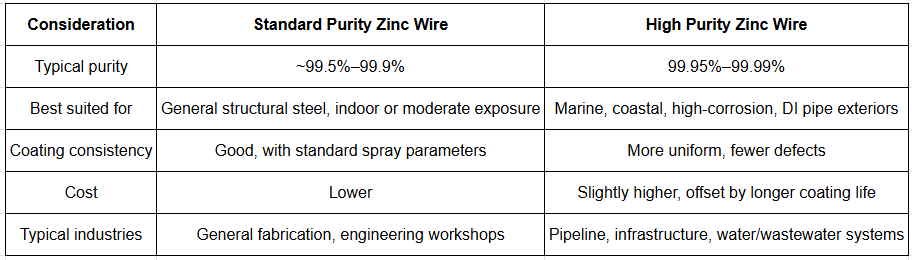
Engineers selecting a grade should factor in the environment the coated part will operate in, the expected service life, and whether the application is covered by a specific industrial standard, such as those governing thermal spray zinc coatings for pipe or structural steel.
Common Industrial Applications of Zinc Wire
- DI pipe manufacturing – exterior corrosion protection coating on ductile iron pipes
- Structural steel – bridges, towers, and industrial structures exposed to weather
- Thermal spray coating shops – general metallization services for corrosion protection
- Galvanizing operations – zinc feedstock for continuous or batch processes
- Marine and offshore equipment – components requiring high corrosion resistance
- Repair and maintenance spraying – restoring worn or corroded machine parts on-site
How to Choose the Right Zinc Wire Specification
1. Confirm your spray equipment’s diameter requirement. Check the gun manufacturer’s specification sheet before ordering, since feeding an out-of-tolerance wire can damage contact tips.
2. Match purity to exposure conditions. Indoor or low-corrosion environments can often use standard purity wire, while coastal, marine, or buried applications justify higher purity.
3. Ask about coil consistency, not just a single spec sheet. A single test certificate doesn’t guarantee every coil in a batch performs the same. Ask your zinc wire supplier about inline diameter monitoring during production.
4. Check packaging and moisture protection. Zinc wire that absorbs surface moisture during storage can oxidize slightly before use, affecting spray quality. Proper coil wrapping matters more than buyers often realize.
5. Confirm RoHS and industrial compliance where applicable. Some end applications, particularly in electronics-adjacent manufacturing, require documented compliance with relevant material standards.
Common Problems Caused by Poor-Quality Zinc Wire
- Porous coatings that fail salt spray or accelerated corrosion testing
- Inconsistent coating thickness, leading to thin spots that corrode early
- Excessive spitting and splatter, wasting material and requiring surface rework
- Frequent contact tip replacement, raising per-part spraying cost
- Batch-to-batch variation, making process qualification difficult to maintain
Most of these problems trace back to inconsistent wire drawing quality or impurity levels that weren’t caught before the wire reached the shop floor – which is why sourcing from an established, quality-controlled manufacturer matters more than chasing the lowest per-kilogram price.
Factors That Affect Zinc Wire Coating Performance
Beyond the wire itself, coating quality depends on:
- Surface preparation – proper blasting and roughening before spraying, since zinc adheres mechanically to a prepared surface
- Spray parameters – correct air pressure, voltage, and wire feed speed for the specific gun and wire diameter
- Ambient conditions – humidity and temperature during application, which affect oxidation during spraying
- Substrate cleanliness – oil, rust, or scale left on the surface will compromise adhesion regardless of wire quality
A high-quality zinc wire performs best when paired with correct surface preparation and spray technique – the wire alone doesn’t guarantee a good result, but a poor wire will undermine even the best technique.
Why Manufacturing Origin and Track Record Matter
Kothari Metsol has manufactured soldering and metallization materials in India since 1967, combining decades of metallurgical experience with German technical heritage and consistent quality control across production.
For zinc wire specifically, that track record translates into tighter diameter control, verified purity levels, and coil consistency that spray shops and pipe manufacturers can rely on batch after batch – supported by a manufacturer that understands how the wire performs downstream, not just how it leaves the factory.
If you’re specifying zinc wire for a metallization or thermal spray application, Kothari Metsol’s technical team can help match diameter, purity, and grade to your exact process requirements.
Frequently Asked Questions
1. What is zinc wire used for?
Zinc wire is primarily used as feedstock in thermal spray metallization to apply a sacrificial, corrosion-resistant zinc coating on steel and iron components, including structural steel and DI pipes.
2. What diameter of zinc wire is used in metallization?
Common industrial zinc wire diameters range from about 1.6mm to 3.2mm, depending on the specific arc spray or flame spray equipment being used. Always confirm the exact requirement from your spray gun’s specifications.
3. What purity level should zinc wire have?
Standard applications typically use 99.5%–99.9% pure zinc wire, while high-corrosion environments such as marine or coastal structures benefit from 99.95%–99.99% purity for improved coating consistency and corrosion resistance.
4. How does zinc wire protect steel from corrosion?
Zinc wire creates a sprayed coating that corrodes sacrificially in place of the underlying steel, a process known as cathodic protection. This keeps the base metal protected even if the coating surface is scratched or damaged.
5. What causes poor zinc coating quality?
Poor coating quality usually results from inconsistent wire diameter, low purity, inadequate surface preparation, or incorrect spray parameters such as wire feed speed and air pressure.
6. Is zinc wire different from zinc metallization wire?
“Zinc wire” and “zinc metallization wire” generally refer to the same product – zinc wire specifically manufactured and drawn to the diameter tolerance and purity required for thermal spray metallization equipment.
7. How do I choose a reliable zinc wire manufacturer in India?
Look for a manufacturer with documented purity testing, consistent diameter tolerance across coils, proper moisture-protected packaging, and a track record of supplying industries like DI pipe manufacturing, galvanizing, and structural steel coating.
8. Can zinc wire be used for both spray coating and galvanizing?
Yes. Zinc wire is used both as feedstock in thermal spray coating equipment and as a zinc source in certain galvanizing processes, though the specification requirements can differ by application.
Conclusion
Zinc wire specifications aren’t a minor detail buried in a datasheet – diameter tolerance, purity, and grade directly determine how well a coating performs in the field, from adhesion and porosity to long-term corrosion resistance. Getting these specifications wrong shows up later as premature coating failure, and by then, the cost of rework is far higher than the cost of sourcing the right wire in the first place.
If you’re specifying zinc wire for a metallization, thermal spray, or galvanizing application, Kothari Metsol’s team can help you match the right diameter, purity, and grade to your process and operating environment. As a zinc wire manufacturer with decades of metallurgical experience, we’re happy to discuss your specific requirements – reach out to request technical guidance or a quotation for your next batch.