Rosin Core Solder: When It Still Beats No-Clean
No-clean flux gets most of the attention these days, and urea flux has carved out its own niche as a cleaner middle ground. But rosin core solder hasn’t disappeared from serious production floors – and for good reason.
Rosin core solder remains the go-to choice in specific situations where its stronger wetting action simply outperforms milder alternatives, particularly on surfaces that aren’t perfectly clean. Understanding exactly when that’s true – and when it isn’t – helps you avoid switching flux types based on trend rather than actual process need.
This guide breaks down where rosin core solder wire still earns its place on the line, how it compares to no-clean and urea flux in real conditions, and how to select the right rosin cored solder wire for your application.
What Is Rosin Core Solder Wire?
Rosin core solder wire is solder wire manufactured with natural or modified pine rosin flux embedded in its core, released as the wire melts during soldering. This flux core solder cleans oxidation from the joint surface and helps the molten alloy wet evenly, producing a strong, reliable connection.
Rosin cored solder wire comes in two main strengths: RA (rosin activated), which offers the most aggressive cleaning action, and RMA (rosin mildly activated), a gentler version suited to less demanding applications.
How Flux Core Solder Wire Works
As heat reaches the solder wire and flux core solder begins to melt, the flux flows ahead of the solder alloy, clearing surface oxides and contaminants from the joint area. Once the surface is clean, the molten solder wets and bonds to the metal, forming the joint as it cools.
The strength of the flux’s activator determines how aggressively it can clean the surface – this is exactly where rosin flux’s advantage over milder chemistries like no-clean flux becomes practically important.
When Rosin Core Solder Still Outperforms No-Clean or Urea Flux
- Working with moderately oxidized or aged components. Rosin’s stronger activators clear oxidation that no-clean flux simply can’t handle, making it the more forgiving choice for rework, repair, or components that have sat in storage.
- Field repair and service work. Technicians working outside controlled factory environments often can’t guarantee pristine surface conditions – rosin core solder’s wetting margin matters more here than residue concerns.
- Applications where post-solder cleaning is already standard. If your process already includes a wash step for other reasons, rosin’s superior wetting performance comes without the usual downside of leaving unmanaged residue.
- High-reliability joints on difficult-to-solder surfaces. Where joint reliability takes priority over cosmetic finish or cleaning convenience, rosin flux’s proven wetting track record still leads.
- Legacy manufacturing lines built around rosin-based process parameters. Switching flux chemistry means requalifying temperature and dwell settings – for lines where rosin already performs reliably, there’s often no practical reason to change.
Rosin Core vs No-Clean vs Urea: Head-to-Head
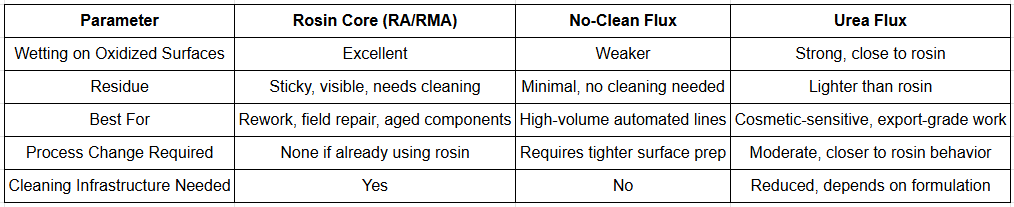
The right choice isn’t about which flux is “better” universally – it’s about matching flux strength to your actual surface conditions and cleaning capability.
Types of Solder Wire With Flux Core: RA vs RMA Rosin
RA (rosin activated) solder wire with flux offers the strongest cleaning action among rosin types, suited to heavily oxidized surfaces or demanding industrial soldering where reliable wetting matters most.
RMA (rosin mildly activated) solder wire and flux provides gentler cleaning, appropriate for cleaner surfaces or applications where minimizing residue corrosivity is a priority while still benefiting from rosin’s wetting reliability.
Choosing between RA and RMA rosin cored solder wire comes down to how oxidized your typical surface condition is and how much residue reactivity your application can tolerate.
How to Choose the Right Rosin Core Solder Wire
- Assess your typical surface condition. Heavily oxidized or aged components favor RA rosin; cleaner surfaces can often use RMA.
- Confirm your cleaning process can handle rosin residue. If cleaning isn’t feasible, rosin may not be the right fit regardless of its wetting advantage.
- Match wire diameter to your joint size and equipment. Fine-pitch work needs thinner wire; general assembly typically uses larger diameters.
- Verify alloy compatibility. Rosin flux core solder wire is available in both leaded and lead-free (RoHS-compliant) alloy formulations.
- Consider your existing process parameters. If your line already performs reliably with rosin, switching flux chemistry may introduce more risk than benefit.
Best Practices When Using Rosin Cored Solder Wire
- Clean residue promptly after soldering, particularly for humidity-exposed or long-service-life applications, to prevent long-term corrosion risk.
- Match iron temperature to the rosin flux’s activation range – overheating can burn off flux before it fully activates.
- Store rosin core solder wire in a dry environment to preserve flux activity and prevent oxidation of the solder surface itself.
- Use RA rosin for genuinely difficult surfaces and RMA where possible, to minimize unnecessarily aggressive residue.
- Inspect joints for the characteristic smooth, bright finish rosin flux typically produces on properly wetted joints.
Common Mistakes to Avoid
- Assuming rosin flux never needs cleaning. Leaving rosin residue uncleaned in humid or long-service environments increases long-term corrosion risk.
- Using RA rosin where RMA would suffice. Unnecessarily aggressive flux adds more residue to manage without a wetting benefit on already-clean surfaces.
- Switching away from rosin without evaluating the real trade-off. No-clean or urea flux isn’t automatically better – rosin’s wetting strength still matters for certain applications.
- Ignoring flux compatibility with your solder alloy. Confirm the rosin flux core solder wire is formulated correctly for your chosen alloy, especially for lead-free applications.
- Overlooking storage conditions. Poorly stored rosin core solder wire can lose flux activity or develop surface oxidation before it’s even used.
Frequently Asked Questions
1. What is rosin core solder wire used for?
Rosin core solder wire is used to solder electrical and mechanical joints, with rosin-based flux embedded in the wire to remove surface oxidation and improve wetting during the soldering process.
2. When should I use rosin core solder instead of no-clean flux?
Rosin core solder is the better choice when working with moderately oxidized or aged components, field repair work, or applications where reliable wetting matters more than avoiding a cleaning step.
3. What is the difference between RA and RMA rosin core solder wire?
RA (rosin activated) offers stronger cleaning action for heavily oxidized surfaces, while RMA (rosin mildly activated) provides gentler cleaning suited to cleaner surfaces with less residue reactivity.
4. Does rosin core solder wire always need cleaning after use?
Cleaning is generally recommended for rosin flux residue, particularly in humid or long-service-life applications, to prevent potential long-term corrosion.
5. Is rosin core solder wire compatible with lead-free alloys?
Yes, rosin flux core solder wire is available paired with both leaded and lead-free (RoHS-compliant) alloy cores.
6. Why do some manufacturers still prefer flux core solder over no-clean or urea flux?
Rosin’s stronger activators provide more reliable wetting on oxidized or aged surfaces, and manufacturers with existing cleaning infrastructure often see no practical benefit in switching away from it.
7. How do I choose between rosin core solder and other flux core solder wire types?
Base your choice on surface oxidation level, cleaning capability, cosmetic requirements, and whether your existing process parameters are already optimized for a specific flux chemistry.
8. What factors affect solder joint reliability with rosin core solder wire?
Flux activator strength, iron temperature control, surface cleanliness before soldering, and proper residue cleaning afterward all directly affect solder joint reliability with rosin core solder wire.
Conclusion
Rosin core solder wire hasn’t been made obsolete by no-clean or urea flux – it remains the right choice wherever surface oxidation, field conditions, or existing process parameters call for stronger wetting performance than milder flux chemistries can deliver. The decision comes down to matching flux strength to your actual soldering conditions, not following the newest trend by default.
Kothari Metsol Pvt. Ltd. has manufactured rosin flux core solder wire and industrial soldering solutions since 1967, combining German technical heritage with rigorous quality control to serve electronics, automotive, and industrial manufacturers across India. If you’re deciding between rosin, no-clean, or urea flux for your production line, our technical team can help you choose based on your actual application requirements.
Explore our rosin core solder wire range and request technical guidance or a quotation.